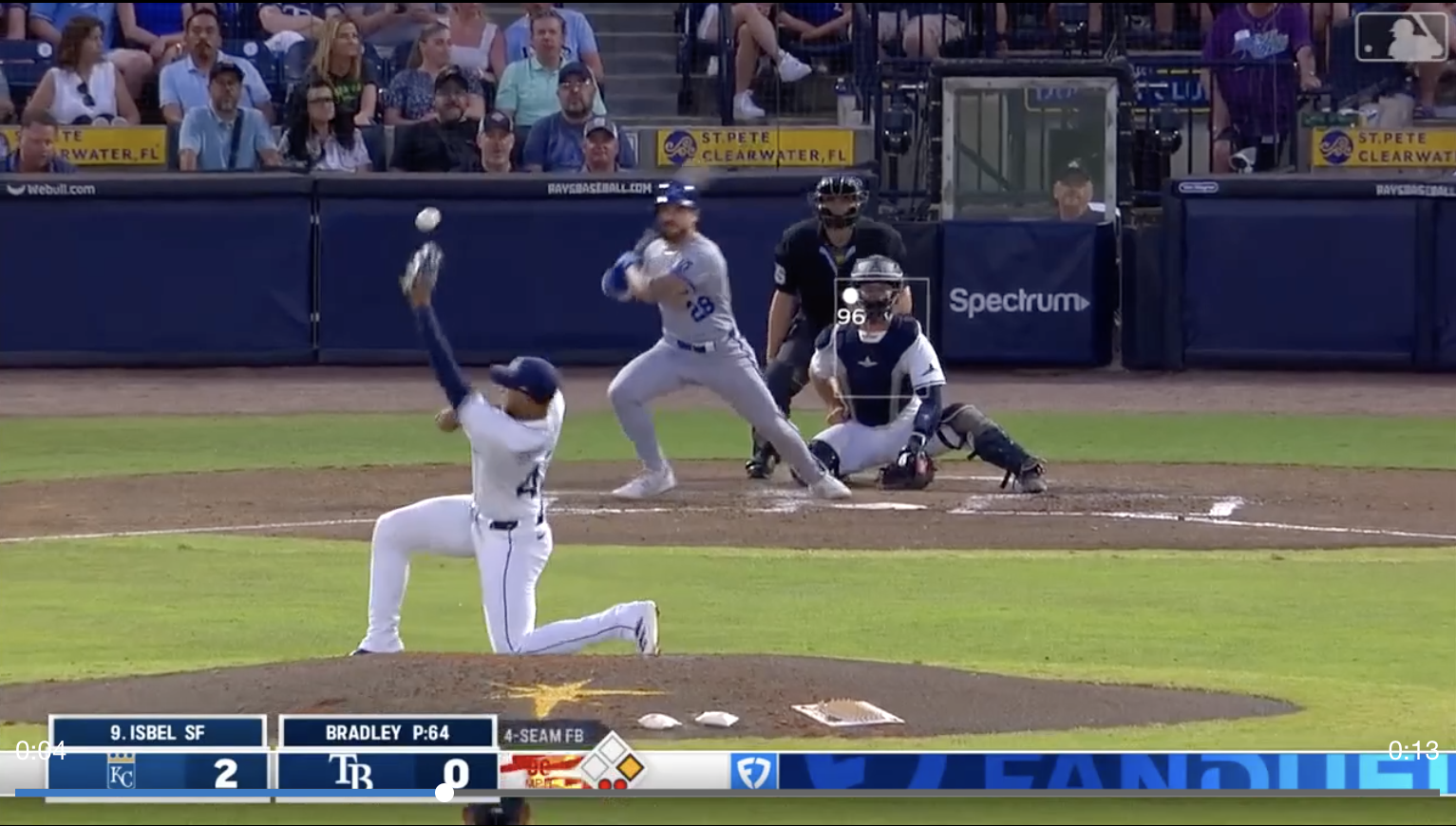
Taj Bradley, of the Tampa Bay Rays, stabs at a line drive off the bat of Kyle Isbel, of the Kansas City Royals.
Infield Line Drive Not Caught
If a batter hits a line drive that does not get caught, but stays in the infield, it generally means one of two things: either the line drive was hit extremely soft, such that it falls in front of a fielder, or it was hit close enough to a fielder that they were able to get a glove (or maybe another body part1) on it, without successfully catching it.
In the latter case, it’s almost certain that the play is not going to be scored as an error, even if the defense can’t convert the play into outs. Why? Because part of the logic of calling an error is that the play in question could be made with “reasonable effort.” Line drives tend to be hit hard enough that catching them is less about skill or effort, and more about sheer reflexes and luck. So, if a line drive gets hit your way and you clank it, you’ll almost never get an error out of it.
Either way, once the ball has hit the ground, it’s almost always going to be in the vicinity of a fielder, and at that point, it’s more or less like any other ground ball. The batter now needs to run to first; any other runners forced to their next base need to be on the move.